
Konzepte 2026
Im Jahr 2026 stehen viele Projekte weiterhin unter dem Druck, technische Systeme zugleich effizient, sicher und sauber vernetzbar zu planen. Gerade bei Modernisierungen, Nachrüstungen und frühen Ausschreibungsphasen lohnt sich deshalb eine präzise Vorprüfung von Fensterantrieben, bevor Montage- und Steuerungskonzepte festgelegt werden.
Entscheidende Prüfpunkte für eine prozesssichere Auswahl und Projektierung
Automatisierte Fenstersysteme sind im professionellen Objektbau längst fester Bestandteil moderner Gebäudeplanung. Sie unterstützen die tägliche Lüftung, lassen sich in gebäudetechnische Konzepte integrieren und übernehmen in bestimmten Projekten auch sicherheitsrelevante Funktionen. Damit eine Antriebslösung später zuverlässig arbeitet, genügt es jedoch nicht, lediglich einen Öffnungsmechanismus auszuwählen. Entscheidend ist die frühzeitige technische Abstimmung aller Randbedingungen.
Genau hier setzt eine strukturierte Vorprüfung an. Sie schafft Klarheit über Einbausituation, Öffnungsgeometrie, Lasten, Anwendungszweck und Sicherheitsanforderungen. Gleichzeitig hilft sie dabei, typische Abstimmungsprobleme zwischen Fensterbau, Fassade, TGA und Gebäudeautomation frühzeitig zu vermeiden. Wer diese Punkte sauber prüft, reduziert das Risiko von Nacharbeiten, Fehlbestellungen und funktionalen Einschränkungen deutlich.
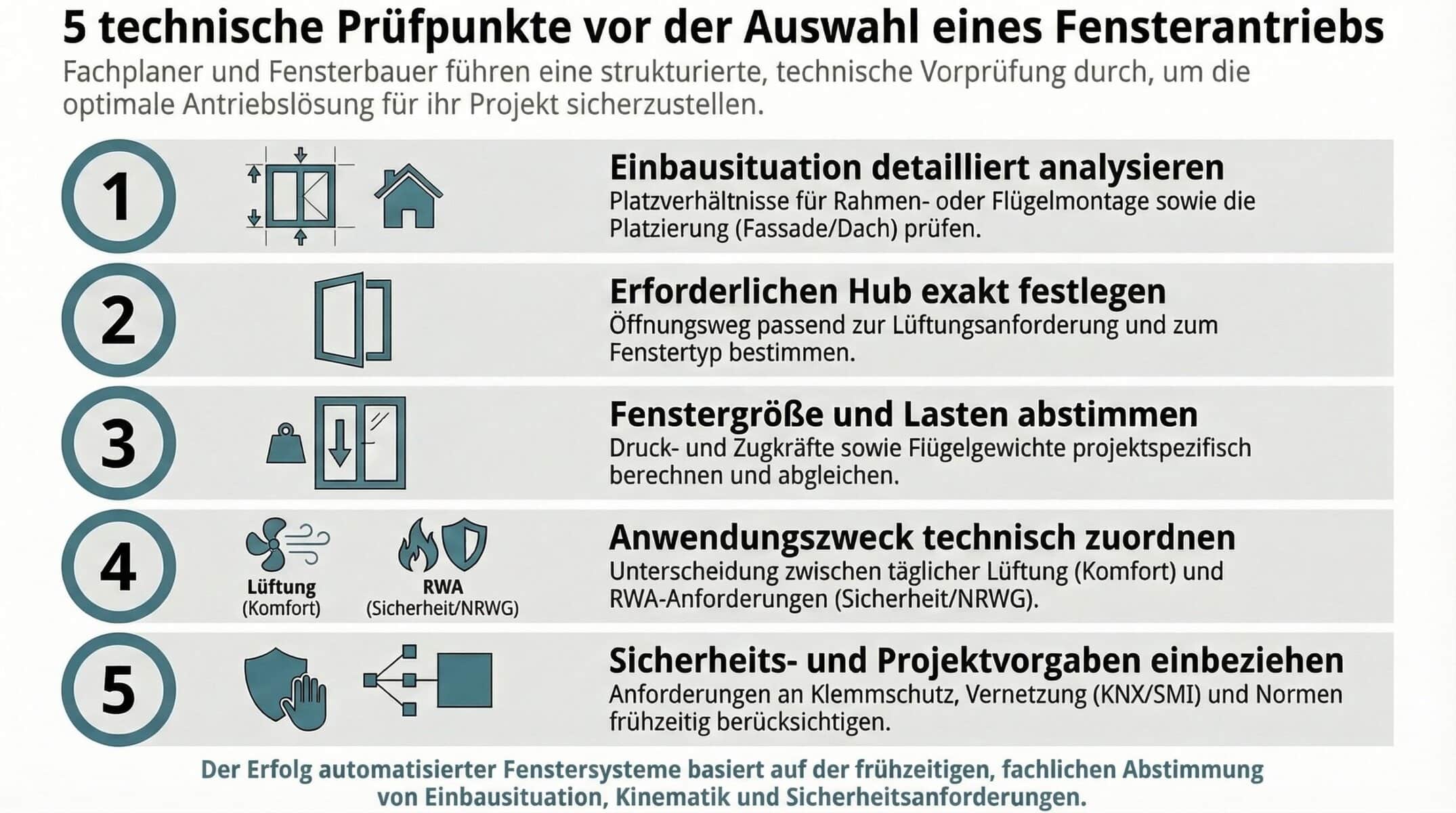
Einbausituation frühzeitig und im Detail analysieren
Die Einbausituation ist in vielen Projekten der erste und zugleich einer der meistunterschätzten Prüfpunkte. Bereits kleine Abweichungen bei Platzverhältnissen, Befestigungsmöglichkeiten oder Öffnungsrichtungen können dazu führen, dass eine grundsätzlich geeignete Antriebslösung später nur mit Kompromissen umgesetzt werden kann. Deshalb sollte die Analyse nicht erst kurz vor Bestellung oder Montage erfolgen, sondern möglichst früh in der technischen Projektabstimmung.
Zu prüfen sind insbesondere die verfügbaren Einbauräume am Rahmen oder Flügel, die Lage des Fensters in Fassade oder Dach sowie angrenzende Bauteile. Auch Sonnenschutz, Innenbeschattung, Fassadenelemente oder andere bauseitige Hindernisse müssen in die Betrachtung einbezogen werden. Gerade bei anspruchsvollen Geometrien reicht eine grobe Einschätzung selten aus. Technisch sinnvoll ist dann eine Bewertung anhand von Detailschnitten, realistischen Einbausituationen oder projektspezifischen Konstruktionszeichnungen.
Kinematik und Montage als funktionale Einheit verstehen
Die spätere Funktion eines Fensterantriebs hängt wesentlich davon ab, wie gut Kinematik, Antriebsposition und Montagekonsole aufeinander abgestimmt sind. Der Hub allein sagt noch nichts darüber aus, ob die Kraftübertragung über den gesamten Öffnungsweg stabil und dauerhaft funktioniert. Maßgeblich ist das Zusammenspiel von Antriebsgeometrie, Hebelverhältnissen und Befestigungspunkten.
In der Praxis bedeutet das: Eine Konsole muss nicht nur montierbar sein, sondern die auftretenden Kräfte dauerhaft sauber in das Bauteil einleiten. Gerade bei beengten Einbausituationen oder filigranen Profilen ist deshalb eine kompakte und technisch passende Konfiguration entscheidend. Eine frühe Prüfung verhindert, dass später improvisierte Lösungen notwendig werden, die Montageaufwand und Gewährleistungsrisiken erhöhen.
Fassaden- und Dachanwendungen unterscheiden sich deutlich
Je nach Projekt unterscheiden sich die Anforderungen bei Fassaden- und Dachfenstern erheblich. Während bei Fassadenanwendungen häufig seitliche oder obere Anschlagssituationen, Windbeanspruchungen und Beschattungseinflüsse relevant sind, spielen bei Dachanwendungen andere Kinematiken, Schwerkrafteinflüsse und Witterungsaspekte eine größere Rolle.
Deshalb sollte die Einbausituation immer im konkreten Nutzungskontext beurteilt werden. Eine Lösung, die an einer vertikalen Fassade technisch schlüssig ist, muss nicht automatisch für ein geneigtes Dachfenster geeignet sein. Die saubere technische Abstimmung beginnt also nicht bei der Geräteauswahl, sondern bei der präzisen Betrachtung des konkreten Bauteils im Projekt.
Erforderlichen Hub exakt festlegen
Der zweite zentrale Prüfschritt betrifft den erforderlichen Hub. In vielen Projekten wird der gewünschte Öffnungsweg zunächst nur grob abgeschätzt. Für eine belastbare Projektierung genügt das jedoch nicht. Der Hub muss so bestimmt werden, dass er sowohl zur gewünschten Lüftungsfunktion als auch zur Geometrie des Fensters passt. Eine Überdimensionierung ist dabei ebenso ungünstig wie ein zu knapp bemessener Öffnungsweg.
Aus technischer Sicht ist zunächst zu klären, welche Öffnungsweite für die vorgesehene Anwendung tatsächlich benötigt wird. Bei täglicher Lüftung stehen häufig Luftwechsel, Bedienlogik und Betriebszyklen im Vordergrund. Bei sicherheitsrelevanten Anwendungen können dagegen andere Kriterien maßgeblich sein. In beiden Fällen gilt: Der Hub ist nur dann sinnvoll festgelegt, wenn er im Zusammenhang mit Fensterart, Öffnungswinkel und Antriebsposition bewertet wird.
Fenstertyp und Öffnungsgeometrie gemeinsam prüfen
Kipp-, Klapp- und Drehfenster verhalten sich hinsichtlich Öffnungsbewegung und Kraftverlauf unterschiedlich. Derselbe Hub kann deshalb je nach Fenstertyp zu sehr verschiedenen Ergebnissen führen. Für Fachbetriebe relevant ist vor allem die geometrische Prüfung, ob sich mit dem gewählten Hub tatsächlich die gewünschte Öffnung herstellen lässt, ohne dass Profile, Beschläge oder Dichtungen unzulässig belastet werden.
Gerade bei projektspezifischen Sonderlösungen sollte nicht nur die Endposition betrachtet werden. Ebenso wichtig ist der Bewegungsverlauf zwischen geschlossener und geöffneter Stellung. Dort entstehen häufig kritische Situationen, etwa wenn Bauteile in den Bewegungsraum hineinragen oder ungünstige Hebelverhältnisse die mechanische Belastung erhöhen. Eine exakte Hubfestlegung schafft hier Planungssicherheit.
Hubbegrenzung gezielt nutzen
Nicht jede maximal mögliche Öffnung ist im Projekt auch funktional erforderlich. In vielen Anwendungen ist es sinnvoller, den Öffnungsweg so zu begrenzen, dass die gewünschte Funktion zuverlässig erreicht wird, ohne unnötige mechanische Beanspruchung zu erzeugen.
Diese Herangehensweise ist vor allem dann relevant, wenn hohe Zyklenzahlen zu erwarten sind oder sensible Profil- und Beschlagssituationen vorliegen. Eine saubere Hubdefinition trägt damit nicht nur zur Funktion, sondern auch zur Dauerhaftigkeit des Gesamtsystems bei.
Fenstergröße und Lasten projektspezifisch abstimmen
Die Größe des Fensters und die daraus resultierenden Lasten bilden den dritten zentralen Prüfpunkt. Fensterantriebe dürfen im professionellen Umfeld nicht allein anhand von Erfahrungswerten ausgewählt werden. Maßgeblich ist vielmehr die konkrete Lastsituation im Projekt. Dazu gehören Flügelgewicht, Glasaufbau, Reibungsverhältnisse, Öffnungsart und äußere Einwirkungen wie Wind oder Schnee.
Besonders wichtig ist die Berechnung der erforderlichen Druck- und Zugkräfte in Newton. Diese Werte bilden die Grundlage für die Auswahl einer technisch passenden Antriebslösung. Ohne belastbare Lastannahmen besteht das Risiko, dass Antriebe entweder unterdimensioniert sind oder unnötig groß ausgelegt werden. Beides ist planerisch ungünstig: Die eine Variante gefährdet die Funktion, die andere erhöht Aufwand und Kosten ohne echten Mehrwert.
Newton-Berechnung nicht isoliert betrachten
Die rechnerische Bestimmung der Kräfte sollte nicht nur auf Idealbedingungen beruhen. Im realen Projekt spielen zusätzliche Faktoren eine Rolle, etwa Reibungsverluste, Toleranzen im Bauteil oder ungünstige Anlenkpunkte. Eine seriöse Auslegung berücksichtigt deshalb nicht nur das theoretische Flügelgewicht, sondern die tatsächlichen Belastungen im Betrieb.
Das gilt insbesondere bei größeren Flügeln, komplexen Geometrien oder Mehrfachantrieben. Dort ist nicht nur die absolute Kraft relevant, sondern auch das Verhalten im Gleichlauf. Wenn mehrere Antriebe zusammenarbeiten, muss sichergestellt sein, dass Lastverteilung, Synchronität und Abschaltverhalten technisch zueinander passen. Andernfalls drohen Verspannungen, ungleichmäßige Bewegungen und vorzeitiger Verschleiß.
Witterung und Einbaulage mitdenken
Bei Fassaden- und Dachanwendungen müssen zudem äußere Lasten in die technische Beurteilung einfließen. Windbeanspruchungen, Schneelasten oder klimatische Einflüsse können die mechanischen Anforderungen deutlich verändern. Ebenso relevant sind Schutzarten und die Eignung der Komponenten für die jeweilige Einbausituation.
In vielen Anwendungen ist deshalb eine isolierte Betrachtung des Fensters nicht ausreichend. Erst die Kombination aus Bauteilgröße, Lage, Lastfall und Betriebsanforderung ergibt ein realistisches Bild. Für Fachplaner und ausführende Betriebe ist genau diese Gesamtsicht entscheidend, wenn eine Lösung im späteren Betrieb zuverlässig funktionieren soll.
Anwendungszweck technisch korrekt zuordnen
Der vierte Prüfschritt betrifft die eindeutige technische Zuordnung des Anwendungszwecks. In der Praxis ist es entscheidend, zwischen täglicher Komfortlüftung und sicherheitsrelevanten Anforderungen zu unterscheiden. Beide Einsatzfelder können äußerlich ähnlich wirken, stellen jedoch unterschiedliche Anforderungen an Antrieb, Steuerung, Auslegung und Dokumentation.
Wird diese Unterscheidung zu spät oder zu unklar vorgenommen, entstehen schnell Planungsprobleme. Dann werden beispielsweise Betriebsspannung, Zyklusanforderungen oder sicherheitsrelevante Eigenschaften nicht passend spezifiziert. Eine frühe und eindeutige Zuordnung ist deshalb ein zentrales Element einer prozesssicheren Projektierung.
Komfortlüftung und sicherheitsrelevante Anwendungen nicht vermischen
Bei Anwendungen der täglichen Lüftung stehen typischerweise regelmäßige Fahrbewegungen, Regelbarkeit und Integration in das Gebäudekonzept im Vordergrund. Hier sind Zyklenfestigkeit, Betriebslogik und eine saubere Kommunikation mit übergeordneten Systemen besonders relevant. Bei sicherheitsrelevanten Anwendungen treten dagegen andere Prioritäten in den Vordergrund, etwa definierte Auslösebedingungen, Systemverfügbarkeit und projektspezifische Sicherheitsanforderungen.
Für die technische Planung ist deshalb wichtig, beide Anwendungszwecke nicht unscharf zu vermischen. Nur wenn der Zweck eindeutig feststeht, lassen sich passende Anforderungen an Spannungsversorgung, Steuerung und Komponenten ableiten. Das erhöht die Planungssicherheit und reduziert spätere Abstimmungsprobleme zwischen den beteiligten Gewerken.
Spannungsversorgung und Betriebsprofil richtig bewerten
Auch die Frage nach der geeigneten Betriebsspannung lässt sich nur im Zusammenhang mit dem Anwendungszweck sauber beantworten. Je nach Projekt können 24-Volt- oder 230-Volt-Konzepte technisch sinnvoll sein. Maßgeblich ist dabei nicht nur die elektrische Infrastruktur, sondern auch das Betriebsprofil des Fenstersystems.
Hinzu kommen Aspekte wie Leitungslängen, Spannungsabfall, Abschaltlogik und Integration in vorhandene technische Systeme. Gerade in komplexeren Projekten sollte diese Bewertung nicht isoliert aus elektrotechnischer Sicht erfolgen, sondern in Abstimmung mit Mechanik, Sicherheitsanforderungen und Gebäudeautomation.
Sicherheits- und Projektvorgaben von Beginn an einbeziehen
Der fünfte Prüfschritt betrifft Anforderungen, die über die reine Bewegungsfunktion hinausgehen. Dazu zählen insbesondere Klemmschutz, projektspezifische Sicherheitsvorgaben, Kommunikationsschnittstellen und technische Richtlinien. Diese Punkte sollten nicht als spätere Ergänzung verstanden werden, sondern als integraler Bestandteil der Antriebsspezifikation.
In vielen Projekten zeigt sich erst spät, dass zusätzliche Anforderungen an Schutzmaßnahmen, Rückmeldungen oder Bus-Kommunikation bestehen. Dann müssen bereits getroffene Entscheidungen nachträglich angepasst werden. Genau deshalb ist es sinnvoll, diese Vorgaben frühzeitig in die technische Klärung einzubeziehen.
Risikobeurteilung und Klemmschutz projektspezifisch festlegen
Klemmschutz darf im professionellen Umfeld nicht pauschal behandelt werden. Welche Maßnahmen technisch erforderlich sind, hängt von Nutzungssituation, Einbaulage und Risikobeurteilung ab. In manchen Anwendungen stehen konstruktive Maßnahmen im Vordergrund, in anderen sensorische Lösungen oder eine abgestimmte Kraftbegrenzung.
Für Fachplaner und Fensterbauer ist dieser Punkt auch haftungsrelevant. Eine frühe Abstimmung schafft Klarheit darüber, welche Schutzmaßnahme im konkreten Projekt erforderlich und technisch sinnvoll ist. Gleichzeitig unterstützt sie eine nachvollziehbare Dokumentation der getroffenen Entscheidungen.
Digitale Schnittstellen in der Gebäudeleittechnik sauber abstimmen
Neben mechanischen und sicherheitsrelevanten Aspekten gewinnen digitale Schnittstellen zunehmend an Bedeutung. In vielen Anwendungen sollen Fensterantriebe nicht isoliert arbeiten, sondern in KNX-, SMI- oder andere gebäudetechnische Strukturen eingebunden werden. Daraus ergeben sich Anforderungen an Kommunikation, Rückmeldung, Parametrierung und Leitungsführung.
Besonders relevant ist die Frage, welche Informationen das System liefern oder verarbeiten soll. Rückmeldungen zur Fensterposition, Zustandsmeldungen oder abgestimmte Lüftungsszenarien können in komplexeren Gebäuden einen erheblichen funktionalen Mehrwert schaffen. Voraussetzung dafür ist jedoch, dass die Schnittstellen frühzeitig abgestimmt und nicht erst in der Inbetriebnahme improvisiert werden.
Gerade bei längeren Leitungslängen, 24-Volt-Systemen oder mehreren gekoppelten Komponenten ist zudem die elektrotechnische Planung von Anfang an mitzudenken. Eine saubere Vernetzung beginnt nicht mit dem Anschlussplan, sondern mit einer technisch konsistenten Spezifikation des Gesamtsystems.
Warum die frühe fachübergreifende Abstimmung entscheidend ist
Die Auswahl von Fensterantrieben ist keine isolierte Produktentscheidung. Im professionellen Umfeld geht es vielmehr um die technische Abstimmung eines Gesamtsystems, in dem Mechanik, Einbausituation, Sicherheit und digitale Integration zusammenwirken. Viele spätere Probleme entstehen nicht durch einzelne Komponenten, sondern durch unklare Schnittstellen und unvollständige Vorprüfungen.
Deshalb ist die frühe fachübergreifende Abstimmung zwischen Planung, Fensterbau, Fassade, Elektro und Gebäudeautomation in vielen Projekten der entscheidende Erfolgsfaktor. Wer Anforderungen früh sauber zusammenführt, verbessert nicht nur die technische Passung, sondern auch die Ausführbarkeit auf der Baustelle und die Stabilität im späteren Betrieb.
Eine strukturierte Vorprüfung hilft dabei, Entscheidungen nachvollziehbar zu machen und Risiken systematisch zu reduzieren. Genau darin liegt ihr praktischer Wert für eine prozesssichere Auswahl und Projektierung von Fensterantrieben.
FAQs - Häufig gestellte Fragen
- Warum muss die Einbausituation vor der Auswahl eines Fensterantriebs so genau geprüft werden?
Die Einbausituation beeinflusst nicht nur, ob ein Antrieb montiert werden kann, sondern auch, ob er später funktional und dauerhaft zuverlässig arbeitet. Platzverhältnisse, Befestigungspunkte, Öffnungsrichtung und angrenzende Bauteile wirken direkt auf Kinematik und Kraftübertragung. Wird dieser Punkt zu spät geprüft, entstehen häufig Schnittstellenprobleme zwischen Fensterbau, Fassade und Gebäudeautomation. Eine frühe Detailanalyse reduziert deshalb Nacharbeiten und schafft eine belastbare Grundlage für die weitere Projektierung.
- Wovon hängt der erforderliche Hub eines Fensterantriebs konkret ab?
Der erforderliche Hub ergibt sich aus mehreren Faktoren gleichzeitig. Dazu zählen der Fenstertyp, die Antriebsposition, die gewünschte Öffnungsweite und der konkrete Anwendungszweck. Ein pauschal angesetzter Hub ist in vielen Projekten nicht ausreichend, weil dieselbe Hublänge je nach Geometrie zu unterschiedlichen Öffnungsbewegungen führt. Technisch sinnvoll ist deshalb eine geometrische Prüfung, die den realen Bewegungsverlauf des Fensters berücksichtigt und mechanische Überlastungen vermeidet.
- Ab wann ist eine Kraftberechnung in Newton wirklich notwendig?
Sobald Fenstergröße, Flügelgewicht, Glasaufbau oder Einbaulage nicht mehr trivial sind, sollte die Kraftberechnung nicht auf Erfahrungswerten beruhen. Für eine seriöse Auslegung ist die Bestimmung der erforderlichen Druck- und Zugkräfte in Newton zentral, weil nur so eine passende Antriebslösung gewählt werden kann. Das gilt besonders bei großen Flügeln, Mehrfachantrieben oder anspruchsvollen Witterungseinflüssen. Auch Reibungsverluste und projektspezifische Toleranzen sollten in die Betrachtung einfließen.
- Warum ist die Unterscheidung zwischen Komfortlüftung und sicherheitsrelevanter Anwendung so wichtig?
Diese Unterscheidung hat direkte Auswirkungen auf Auslegung, Steuerung und technische Anforderungen des Gesamtsystems. Bei täglicher Lüftung stehen typischerweise Betriebszyklen, Regelbarkeit und Integration in Lüftungsszenarien im Vordergrund. Bei sicherheitsrelevanten Anwendungen sind dagegen andere Kriterien maßgeblich, etwa definierte Funktionsanforderungen und projektspezifische Sicherheitsvorgaben. Wer beide Einsatzzwecke nicht sauber trennt, riskiert unklare Spezifikationen und spätere Anpassungen im Projektverlauf.
- Welche Rolle spielen KNX, SMI oder ähnliche Schnittstellen bei Fensterantrieben?
Digitale Schnittstellen werden immer dann relevant, wenn Fensterantriebe in ein übergeordnetes Gebäudekonzept eingebunden werden sollen. Das betrifft zum Beispiel Zustandsmeldungen, Fensterpositionsrückmeldungen oder die Einbindung in automatisierte Lüftungsszenarien. Für eine stabile Funktion reicht es jedoch nicht, die Schnittstelle nur grundsätzlich vorzusehen. Erforderlich ist eine saubere technische Abstimmung von Kommunikation, Parametrierung, Leitungslängen und Spannungsversorgung. Genau diese Punkte sollten bereits in der Vorprüfung berücksichtigt werden.
Fazit
Die Auswahl von Fensterantrieben ist im Objektbau vor allem dann belastbar, wenn sie auf einer strukturierten technischen Vorprüfung basiert. Einbausituation, Hub, Lasten, Anwendungszweck und Sicherheitsvorgaben sind keine isolierten Einzelthemen, sondern eng miteinander verknüpfte Parameter. Werden sie frühzeitig und fachübergreifend abgestimmt, entsteht eine deutlich bessere Grundlage für Planung, Ausschreibung, Montage und Inbetriebnahme.
Für Fachplaner, Fensterbauer, Metallbaubetriebe und Systemintegratoren liegt der praktische Nutzen vor allem in höherer Prozesssicherheit. Technische Konflikte lassen sich früher erkennen, Schnittstellen klarer definieren und projektspezifische Anforderungen sauber dokumentieren. Gerade bei automatisierten Fenstersystemen ist diese methodische Vorgehensweise oft der Unterschied zwischen einer formal passenden und einer im Betrieb wirklich stabilen Lösung.