
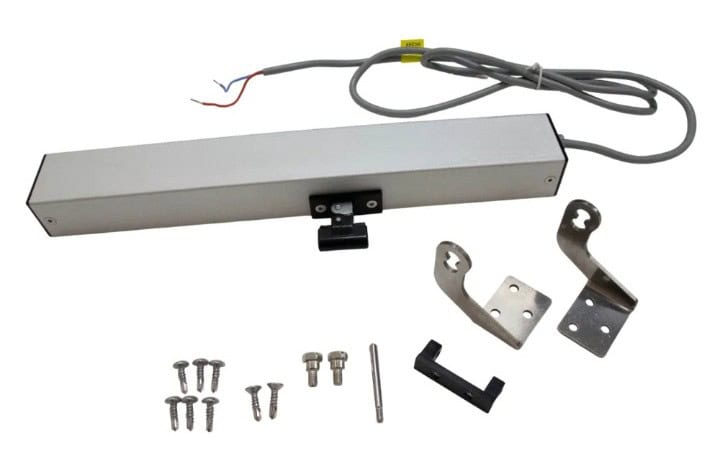
In most cases an existing window can be motorised afterwards – without a new window and usually without major alterations. Whether it is a tilt window in an office, a fanlight in a stairwell or a roof window in a hall: what matters is the sash type, weight, required opening width and how the window is to be operated. This guide shows which actuator fits and what window installers, electricians and contractors should look out for when retrofitting.
Which windows can be retrofitted with electric openers?
- Tilt and top-hung windows: the most common case. The actuator sits on the frame or the sash and pushes the sash open.
- Fanlights: hard-to-reach fanlights in stairwells, corridors and halls are ideal candidates – the actuator replaces the lever or rod.
- Roof windows and rooflights: sash weight, snow and wind loads come into play here, so a higher force is needed.
- Side-hung windows: only to a limited extent – chain actuators usually open side-hung sashes just a gap for ventilation.
Which actuator suits which window?
| Mission | Recommendation | Note |
|---|---|---|
| Tilt, top-hung and facade windows | VS-KA chain drive (250–1500 N, 24 V or 230 V) | compact, chain retracts into the housing |
| Concealed installation in the profile | Built-in chain drive VS-CKA 300 | flat design, stroke up to 1000 mm |
| Heavy roof windows and rooflights | Linear actuator VS-LA (600–5000 N) or VS-KA 2500 | robust against wind and snow loads |
| Very heavy rooflights | Spindle actuator VS-SA 2500 | 2500 N, stroke up to 1000 mm |
| Operation without power | Mechanical chain actuator VS-MKA | manual opening, e.g. by crank |
Determining force and stroke correctly
The actuator force must match the sash weight and the installation situation – with roof windows, wind and snow loads are added. If in doubt, choose the next higher force rating. The stroke determines how far the window opens. Our guide shows how to calculate it from sash height and opening angle Calculate chain length.
24 V or 230 V?
For a single window used for comfort ventilation, a 230 V actuator connected directly to the mains is often sufficient. If several windows are to move together, wind and rain sensors are to be integrated or smoke and heat ventilation (SHEV) is required, 24 V with a control unit is the better choice. The differences in detail: Window actuator: 24 V or 230 V?
Operation: switches, control units and sensors
A retrofitted window is usually operated via a Ventilation button . With a 24 V control unit such as the VS-C24-7A several actuators can be moved together and sensors connected – for example the Wind-rain light sensor VS-WRLS, which closes the windows automatically in rain or storm. More on this in the guide Ventilation control for window actuators.
Installation and safety
- Use original brackets and align the actuator precisely so that no leverage forces act on the window and fittings.
- For windows installed below a height of 2.5 m, reliable anti-trap protection is required.
- Work on 230 V cables must be carried out by a qualified electrician.
- If the window is also to serve as a smoke vent, the actuator, window and an approved SHEV control panel must be coordinated for the specific project. Background: RWA vs. NRWG.
A step-by-step overview of installation can be found in the article Properly install an electric window drive. If an existing actuator is defective, the guide Replacing window drives.
Specifically for fanlights with crank or lever: Retrofitting electric fanlight openers. The electrical connection is explained in the guide Connecting a chain actuator.
Frequently asked questions
Can I retrofit an ordinary tilt window with an electric opener?
Yes. For tilt windows, a chain actuator such as the VS-KA is the usual solution. It is mounted on the frame and opens the sash via a switch or control unit.
How much force does the actuator need?
That depends on sash weight, size and installation position. For light tilt windows 250 N is often enough; for roof windows and rooflights 600 N and more is common.
Do I need a control unit?
A 230 V actuator can run directly via a ventilation switch. 24 V actuators need a control unit or power supply – in return, several actuators and sensors can be integrated.
Does the window close automatically when it rains?
Yes, if a rain or wind-rain-light sensor is connected to the control unit.
Planning a retrofit?
Send us the window type, dimensions, sash weight and a photo – we will name the right actuator with brackets, from stock in Hamburg. To the contact form or call +49 40 50694631.