
Chain drives In many building projects, automated opening and closing of vertical facade windows is a natural solution. Crucially, it's not just the drive system itself that matters, but also its precise coordination with the opening mechanism, installation situation, profile geometry, load case, and control concept. Especially in professional environments, a drive system must not only function but also be technically integrated and operate reliably over the long term.
In practice, it quickly becomes apparent that tilt, turn, and casement windows have different requirements regarding stroke, force, mounting, and kinematics. Added to this are architectural specifications, limited installation space, and the desire for the most discreet integration possible into the facade. The following article categorizes typical application areas and shows what specialist companies, planners, and project managers should consider when selecting chain drives.
Fundamentals of chain drive technology in facade automation
Chain drives operate with a rigid chain that enables linear opening movements of facade windows. This operating principle combines a compact design with a power transmission suitable for many window types. This is particularly relevant for vertical facade elements, as the available installation space in the profile and connection area is often limited.
Unlike other drive types, chain drives are typically suitable where a slim design, linear motion transmission, and visually discreet integration are required. This is a practical advantage for modern facades with narrow sightlines, as technical function and architectural impact can be better coordinated.
However, this does not mean that a chain drive is automatically the right solution for every application. The project-specific parameters are always decisive. These include, among other things, window size, sash weight, opening direction, pivot point, required ventilation cross-section, and the desired behavior in the end positions.
Optimal automation of tilt and turn windows
Tilt and turn windows are among the classic applications for chain drives in facades. Both types of opening often serve for controlled natural ventilation, but differ significantly in their mechanical stress and in the requirements for the design of the drive.
While tilt windows open inwards, requiring consideration of the space required inside, casement windows open outwards. This results in differences in airflow, weather exposure, hardware stress, and the optimal positioning of the drive unit.
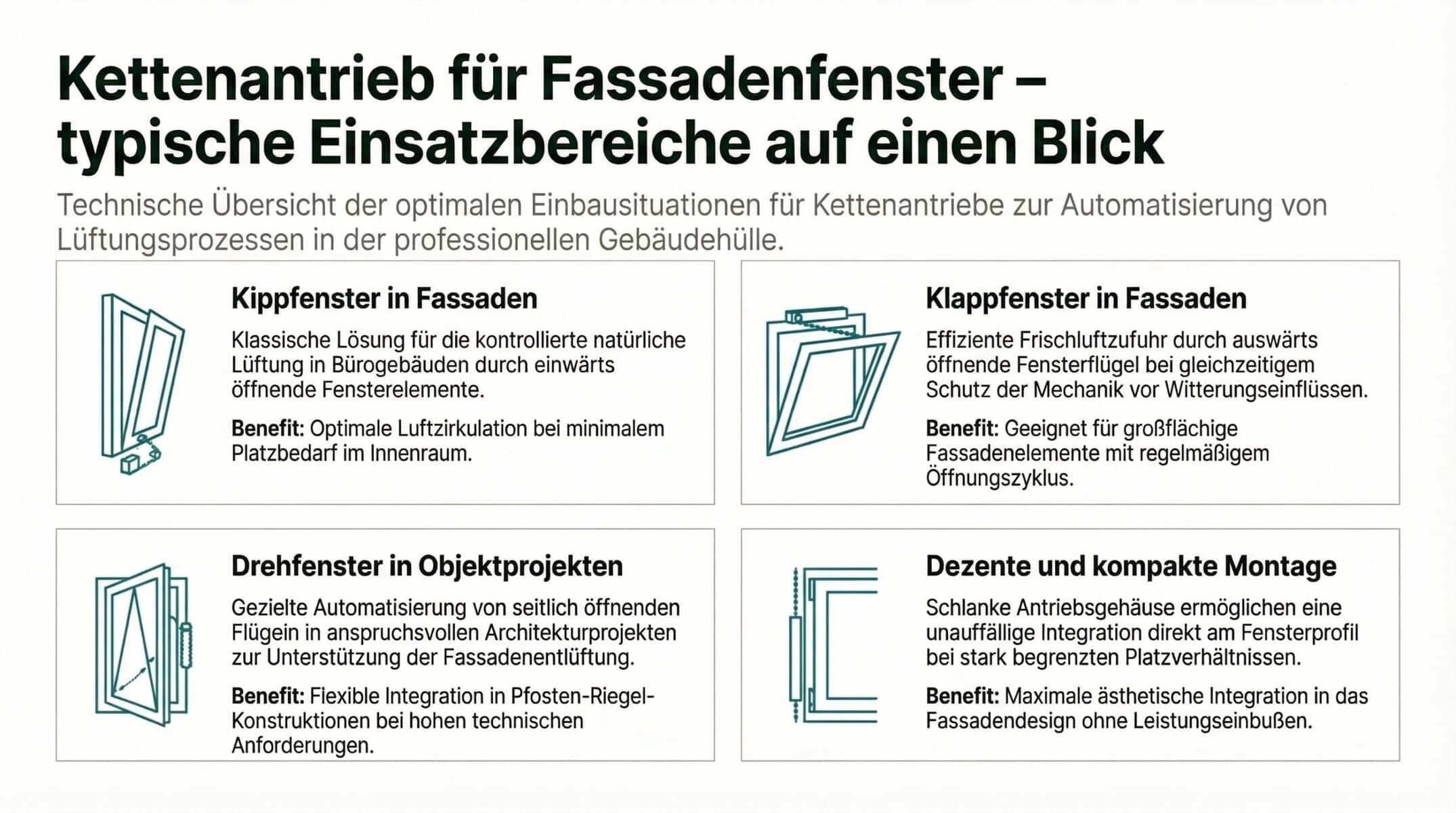
Tilt windows in facades: optimal air circulation with minimal space requirements
Tilt windows in facades are frequently used where controlled natural ventilation with a clearly defined opening behavior is desired. In office and administrative buildings, not only the opening width is relevant, but above all the actual ventilation cross-section achieved in relation to the room layout and the thermal load.
The stroke length of the drive is therefore a key design criterion. A longer stroke does not automatically lead to optimal ventilation. Rather, what is crucial is the effective opening created at the specific window element and how this integrates into the overall ventilation concept of the building.
Another advantage of tilt windows in many applications lies in their comparatively small projection into the interior. This facilitates integration into work and traffic areas and supports functional planning in confined spaces. For specialist companies, it is particularly important in this context that the drive mechanism, hardware, and sash geometry are precisely coordinated.
Hinged windows in facades: high airflow and protection of the mechanism
Outward-opening casement windows are an attractive option in many projects where high airflow is required while simultaneously optimizing the positioning of the mechanism within the facade structure. The opening motion typically facilitates efficient fresh air supply and can offer advantages, particularly with large-area elements, during regular opening cycles.
The outward movement allows for better consideration of weather protection aspects, depending on the installation situation. This applies particularly to the design of the drive and fittings, as well as how to reduce the effects of weather on moving components.
However, during the planning phase, it is important to note that outward-opening elements require thorough testing of wind load, end-position behavior, and closing forces. Resistance to driving rain and reliable locking in the closed position must also be integrated into the overall technical concept.
Chain drives in building architecture: rotating windows and special designs
Side-opening casement windows place higher demands on technical coordination because leverage and hinge loads result in different load situations than with tilt or turn windows. Nevertheless, chain drives can be a sensible solution if the sash kinematics, the position of the pivot point, and the required forces are correctly considered on a project-specific basis.
This type of opening is particularly relevant in building projects with architecturally sophisticated facades. In these cases, the focus is often not only on ventilation, but also on a structurally and aesthetically sound integration into post-and-beam constructions or other complex facade systems.
Rotating windows in building projects: flexible integration with high technical requirements
With casement windows, the forces acting on the sash differ from those of linear tilt or turn movements. This means that leverage effects, the hinge side, and the transmission of the operating force must be considered particularly carefully during the planning phase. A general, one-size-fits-all approach is usually not technically sound in this case.
Especially with larger or heavier sashes, it is important to check whether the chosen position of the drive allows for smooth movement across the entire opening range. At the same time, the hardware, mounting points, and profile statics must be coordinated to prevent any unfavorable additional loads.
In many building applications, it has been shown that casement windows can be sensibly automated where flexible integration into the facade architecture is required and the technical concept is coordinated with the window and facade planning at an early stage.
Integration and design: Mounting options in the profile context
Besides the actual opening function, the type of installation is often crucial for the success of a project. In modern facades, the question of whether a drive unit should be visibly mounted or integrated as discreetly as possible near the profile or into the structural framework plays a major role.
The narrower the visible widths and the higher the design requirements, the more important a discreet design becomes. Chain drives offer advantages in many applications because their housing shape allows for a visually unobtrusive integration without necessarily resulting in a loss of performance.
Discreet and compact mounting in limited installation space
In many facade systems, space for additional technical components is severely limited. Therefore, the compact design of the drive unit is not only an aesthetic but, above all, a functional criterion. A slim housing design can help to accommodate the drive unit directly on the window profile or within the immediate profile depth.
Cable routing, connection technology, and accessibility for servicing are also relevant for planning. A visually clean solution always requires that mechanical and electrical interfaces are considered early on.
Material and surface finishes also play a role in professional settings. Depending on the project, matching the drive housing to the profile system in terms of color or material can be beneficial to create a harmonious facade appearance.
Design and dimensioning of drive systems
Selecting a suitable chain drive doesn't begin with the product itself, but with the technical requirements. A thorough analysis of the loads to be moved, the opening geometry, the desired stroke, and the operating conditions during subsequent building use is essential.
It should be noted that the chain's back stiffness, due to its design, influences its behavior under compressive load. Electronic load cut-off, end position settings, protection rating, and the quality of the mounting brackets are equally relevant. These factors directly affect operational reliability, service life, and repeatability.
Determine force requirements and stroke length professionally
For a technically sound design, the required tensile and compressive forces must be determined based on the specific window situation. Window dimensions, sash weight, hardware arrangement, and the installation position of the drive significantly influence the resulting forces.
Equally important is choosing the appropriate stroke length. It must be dimensioned to ensure the required ventilation cross-section is reliably achieved without creating unnecessary mechanical stress or unfavorable opening angles. Precise coordination is particularly crucial for project windows with unusual geometries.
24 V DC or 230 V AC: suitable power supply in the project context
In many applications, the choice of power supply depends on the overall control concept. 24 V DC systems are often relevant where centralized control, safety requirements, or finely tuned regulation are paramount. 230 V AC solutions can be advantageous in other project configurations if the system design and infrastructure are appropriately configured.
It is important not to consider the power supply in isolation. It is always linked to building automation, cable routing, power supply design, and the requirements for maintenance and operational reliability.
Synchronous operation with large-format window elements
For wide or heavy window elements, the use of two drives may be necessary. In such cases, reliable synchronous operation control is of central importance. This is the only way to ensure that both drives operate evenly and that no tension develops in the sash or the hardware.
This point is particularly important for specialist planners and contractors because inefficient movement patterns can not only impair function but also shorten the service life of mechanical components. Therefore, especially in continuous operation, synchronous movement should be considered an integral part of the project planning.
Important technical aspects during operation
In addition to the initial planning, the subsequent operation of the system should also be considered. This includes, among other things, protection ratings for different facade zones, the quality of the end position adjustment, and cycle stability appropriate to the application profile.
Equally important are realistic maintenance intervals and well-designed accessibility. In professional buildings, long-term operation is only economical if the drive, console, electrical connection, and window mechanism are considered as a coordinated overall system.
Conclusion: Select chain drives on a project-specific basis, not as a general rule.
Chain drives are the primary solution for automating vertical facade elements in many applications. They are particularly advantageous for tilt and turn windows when a compact design, defined opening movement, and discreet integration are required. They can also be used effectively for casement windows and special shapes, provided the load situation and movement geometry are carefully analyzed.
For specialist companies, planners, and project managers, the key lies in project-specific design. Suitability is not determined solely by the drive type, but rather by the coordination of opening mechanism, force requirements, stroke length, mounting concept, power supply, and control system. This is precisely where the technical quality that matters in professional commercial projects is created.
FAQ: Frequently asked questions about chain drives for facade windows
What stroke length is required for an optimal ventilation cross-section in tilt windows?
This cannot be determined generally using a standard value. The decisive factors are the window geometry, the type of stop, the installation position of the drive, and the actual ventilation cross-section required in the specific usage context. The stroke length should therefore always be determined based on the specific opening situation.
Can chain drives also be used with heavy triple-glazed insulating glass units?
In principle, this is possible if forces, leverage, and fastening are professionally designed. The decisive factor is not just the weight of the glass, but the entire sash construction, including hardware, profile statics, and pivot points. A project-specific assessment is therefore essential.
What needs to be considered when synchronizing two drives on a wide window sash?
A reliably controlled synchronization of both drives is essential. This is the only way to avoid tension, uneven loads, and malfunctions. In addition to the control system, the mechanical parameters of the window must also be precisely coordinated.
Are chain drives suitable for use in smoke and heat exhaust ventilation systems?
This depends on the specific system design and application requirements. Smoke and heat extraction systems have different parameters than purely comfort or ventilation automation systems. Therefore, it is always necessary to verify whether the specific drive unit and the overall system are designed for this task.
How are the drives integrated into a central building management system?
Integration typically occurs via the project's existing control and supply concept. Relevant aspects include interfaces, power supply, cable routing, and the required logic for ventilation or security functions. Technical coordination with building services engineering (MEP) and building automation planning should begin early in the process.
What role do mounting brackets play in power transmission?
Mounting brackets are not a secondary consideration, but an essential component of the overall system. Their position, rigidity, and fastening directly influence how forces are transferred into the window and facade. An unsuitable bracket can cause problems even with a properly selected drive unit.
Why is a compact design so important in facade projects?
Because modern facades often offer limited installation space while simultaneously having to meet high design requirements, a compact design facilitates integration into slim profile systems and supports a calm architectural effect without unnecessarily dominant technology.
Suitable products: VS-KA chain drive (250–1500 N), VS-KA-i smart chain drive (with bus integration) and VS-CKA 300 built-in chain drive (300 N, concealed mounting). An overview of all drives can be found in the Vent Systems Shop.