
Updated: 21.11.2026
The absolute humidity indicates how many grams of water vapour are contained in one cubic metre of air (g/m³). Unlike relative humidity , it does not depend on temperature: the amount of water stays the same even when the air gets warmer or colder.
Absolute and relative humidity compared
| Air | relative humidity | absolute humidity (approx.) |
|---|---|---|
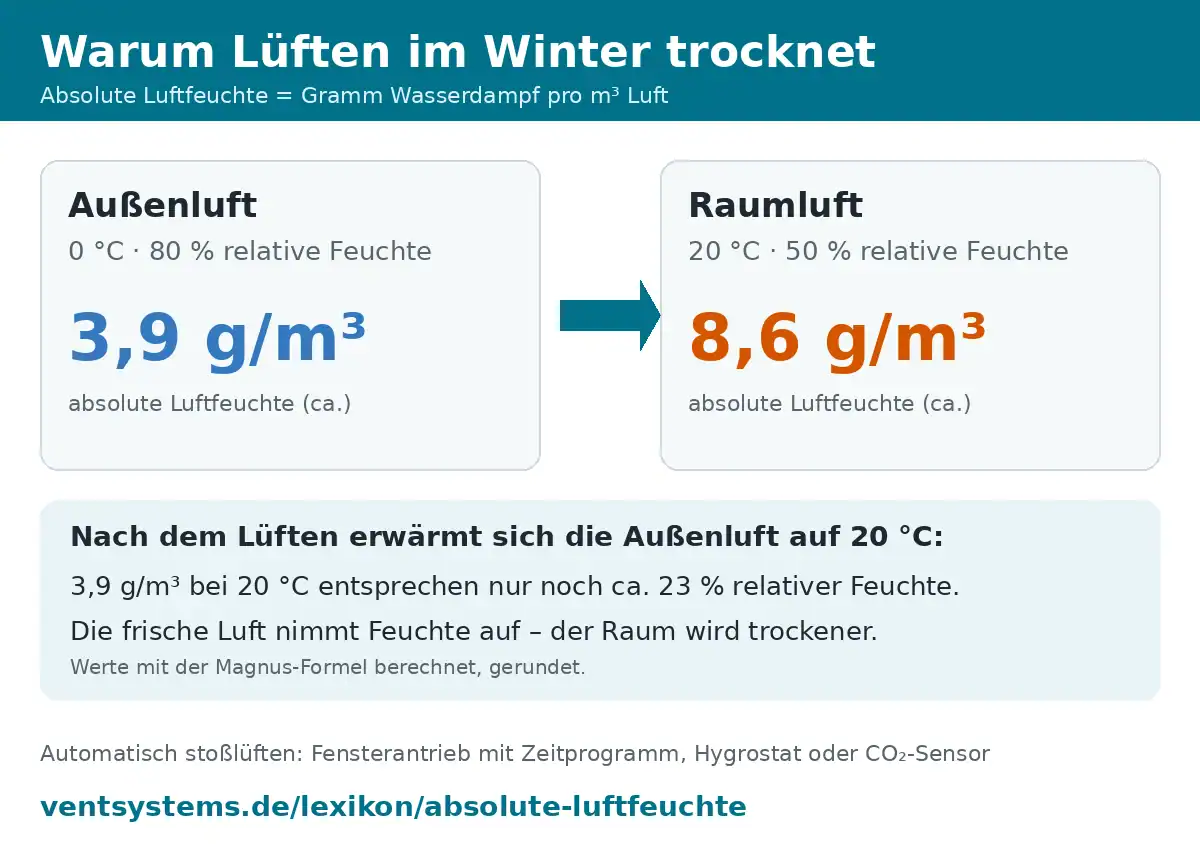
| outside 0 °C | 80 % | 3,9 g/m³ |
| inside 20 °C | 50 % | 8,6 g/m³ |
| inside 20 °C, saturated | 100 % | 17.3 g/m³ |
Example: cold winter air with 80 % relative humidity contains less water than warm room air with 50 %. That is why ventilating in winter dehumidifies the room, even though the outside air seems “humid”. Values calculated with the Magnus formula, rounded.
Absolute humidity calculator
Absolute humidity: – g/m³
Calculated with the Magnus formula (approximation).
What it means for window ventilation
How much moisture is removed by ventilating depends on the difference in absolute humidity inside and outside and on the Air change rate . Automatically opening windows with Hygrostat and ventilation control help to ventilate humid rooms such as showers or pool halls regularly. Condensation forms as soon as a surface is colder than the Dew point .
Note: The permissible humidity in a room is set by planners and operators. This page does not replace ventilation planning.
Humidity in buildings: Dew point · Relative humidity · Absolute humidity · condensation · Hygrostat · Air change rate · Purge ventilation
Related terms: Hygrostat · condensation · Ventilation control (window control) · Air change rate