Updated: 21.11.2026
In short: In indoor pools, actuators on rooflights and windows often fail after just a few years because warm, humid and chlorinated air condenses on the components. Suitable replacements are encapsulated 24 V actuators with a high protection class, stainless steel parts and a control unit in a dry plant room. We supply such actuators from stock in Hamburg – usually much cheaper than replacements from the original manufacturer.
Why window actuators wear faster in indoor pools
The hall air is usually 30–34 °C with 40–64 % relative humidity. It condenses on cool frames, rooflights and skylights. The condensate contains chlorine compounds from the pool water, dries and accumulates on chains, spindles, screws and housings. These parts are mounted high up and rarely cleaned.
Standards assign indoor pool halls to corrosivity category C4 (DIN EN ISO 12944-2). Many standard chain actuators only have protection class IP32 and, according to manufacturers, are intended for dry rooms without condensation. Typical consequences: the chain or spindle rusts and jams, moisture gets into the electronics, the actuator no longer moves or only on one side.
What matters when replacing actuators in a pool
- 24 V DC instead of 230 V: Extra-low voltage at the window; mains voltage stays in the plant room.
- High protection class: encapsulated actuators with IP65 or higher instead of an open design with IP32.
- Design: Rack and linear actuators have a more enclosed design than chain actuators – the first choice for rooflights above the pool.
- Stainless steel: Brackets, screws and chain or rack made of stainless steel, in pools preferably A4. Standard A2 stainless steel is a risk in chlorine air.
- Mount the control unit in a dry place: The ventilation control unit belongs in the plant room or a dry side room, never in the pool hall.
- Install outside the condensation zone: Feed cables in from below and lay them with a drip loop.
- Maintenance: Power-operated windows must be inspected at least once a year by a competent person (ASR A1.6). In pools, an additional visual check for corrosion is worthwhile.
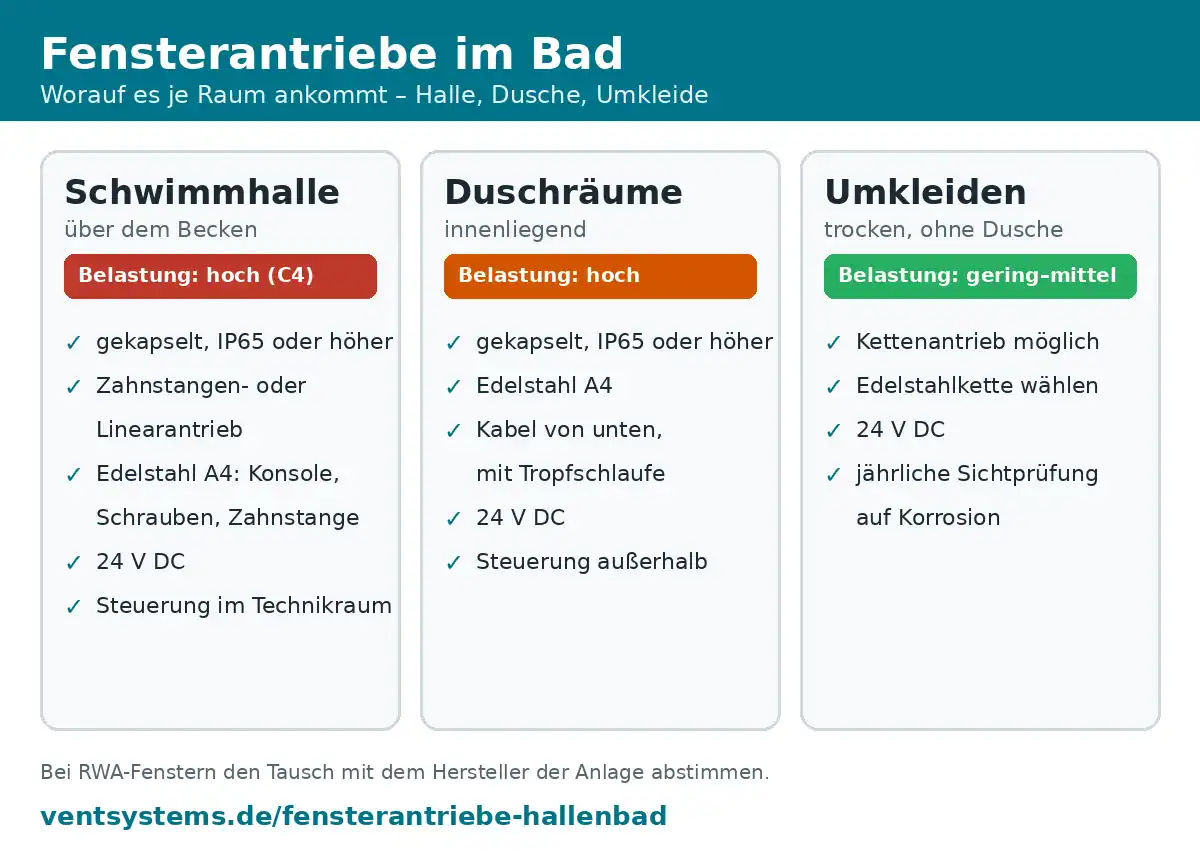
Typical installation locations in pools and suitable actuator type
| Location | Window | usual actuator type | what to watch out for |
|---|---|---|---|
| Pool hall | Rooflight, fanlight, continuous rooflight | Linear actuator (spindle) or chain actuator | Stroke and force for the dome size, protection rating (IP) |
| Shower | Tilt or fanlight window | Chain actuator | Condensation, mounting position, protection rating |
| Changing room | Bottom-hung window, transom window | Chain actuator | Control with timer or humidity switching |
| Stairwell | Rooflight or window at the top | Linear actuator or chain actuator | Smoke exhaust function? Then the SHEV specialist decides |
The table shows typical cases. Which actuator fits in an individual case depends on the type plate, voltage, stroke, force and bracket of the old actuator.
Which actuators we offer for pools
| Application | Actuator | Why |
|---|---|---|
| Rooflight, ventilation flap | VS-ZA 800 / VS-ZA-i | Rack actuator with stainless steel rack, enclosed design, 24 V |
| Rooflight, heavy skylight | VS-LA / VS-LA-i | Linear actuator (spindle), IP65, thrust up to 5000 N |
| Façade window, top-/bottom-hung sash | VS-KA 2500 | Double chain actuator with IP66, stainless steel chain available |
| Dry side rooms | VS-KA | Compact chain actuator, stainless steel chain available |
We clarify in writing in advance which materials your application requires – for example, how high the windows are above the pool and whether they are cleaned regularly. The i-series (VS-ZA-i, VS-LA-i) also has a Modbus interface for building management systems.
For ventilation windows only – not for smoke vent systems
Our actuators are intended for daily ventilation. There is no test certification according to EN 12101-2 for them. If a window or rooflight is part of a smoke and heat exhaust system (SHEV) or is tested as an NSHEV, replacing the actuator must be agreed with the system manufacturer or your specialist contractor. We only supply ventilation controls, no SHEV control panels.
How the replacement works
- Send a photo: Photograph the type plate, actuator and window and send the photos via Send a photo . We will tell you which actuator fits.
- On-site check: In the Hamburg region we will visit on request, look at the system and bring samples.
- Quotation: You receive a written quotation with a price per actuator, also for several pools together.
- Delivery: We ship stock items the same day. In the Hamburg region we also deliver in person.
Frequently asked questions
How long does a window actuator last in an indoor pool?
That depends heavily on where it is installed. Actuators directly above the pool and in shower rooms wear fastest, often after just a few years. Actuators in dry side rooms last much longer. Regular visual checks and cleaning extend their service life.
Will a replacement actuator work with my existing control unit?
We check this in advance: voltage (24 V or 230 V), DC or AC, residual ripple of the power supply, synchronous running of several actuators on one sash, and the bracket. Please send us a photo of the type plates of the actuator and the control unit.
Does the new actuator have to be made of stainless steel?
For parts in the pool hall, yes – at least the chain or rack, brackets and screws. In chlorine air, A4 stainless steel is considered the minimum standard if the parts are cleaned regularly. Standard A2 stainless steel is a risk there.
Do you also supply outdoor pools and changing rooms?
Yes. In outdoor pools, rooflights and windows are mainly found in the internal changing and shower rooms. Shower rooms have similar requirements to the pool hall; dry changing rooms are under less stress.
At what temperature do panes mist up in an indoor pool?
With the usual hall air of 30–34 °C and 60–64 % relative humidity, the dew point is about 21 to 26 °C. Every surface that is colder – glass, frames, rooflights or actuator housings – mists up. The dew point calculator further down this page works out the values for your hall (Magnus formula, rounded).
Basics and terms
When panes in the hall mist up is shown by the dew point calculator: enter the hall temperature and humidity. More in the glossary Dew point.
Dew point calculator
Dew point: – °C
Calculated with the Magnus formula (approximation). Surfaces that are colder will mist up.
This page is based on: VDI 2089 (indoor climate in swimming pools), DIN EN ISO 12944-2 (corrosivity categories), information sheet 831 “Stainless steel in swimming pools” by the Informationsstelle Edelstahl Rostfrei, and ASR A1.6 (windows, skylights). Terms explained: Corrosivity category · Stainless steel A2 and A4 · Protection class (IP code) · Dew point · Hygrostat. For the annual inspection: Checklist for power-operated windows (PDF).
As of November 2026 · Author: Dietmar Heiken, sales and technical support at Vent Systems, around 20 years of experience with window actuators.
Contact
Actuator faulty? Send us a photo via Send a photo or write to us via Contact. Phone: +49 40 50694631 (Mon–Fri 8 am–5 pm).
More on this topic: Ventilating indoor pools with window actuators · Replacing a rooflight actuator · Replacing window drives · Schools and sports halls · Caretakers and facility management
More sectors: Window actuators by sector – indoor pool, school, facility management, maintenance companies, retail, care home, hotel and more.
Technically reviewed by Dietmar Heiken, Sales, Vent Systems HDI GmbH, Hamburg – around 20 years of industry experience. Questions? Phone +49 40 50694631 or info@ventsystems.de
Last updated: 21.11.2026